Showing posts with label Mastura Monif. Show all posts

28 Feb 2022

Brain disease patients to benefit from CCS-led study: Rare Disease Day feature

L-R: Patient advocate Amanda and CCS researcher Dr Mastura
Monif talk about the experience of living with the illness and the
challenges of research into the disease. See video (2:19 mins).
Part of our special series for Rare Disease Day featuring patient advocates and CCS researchers 

The Department of Neuroscience’s Dr Mastura Monif is involved in research about Autoimmune Encephalitis, which affects 5-15 in 100,000 people. Autoimmune Encephalitis is a type of brain inflammation caused when the immune system mistakenly attacks healthy brain cells.  

Awareness day brings rare diseases out of the shadows

CCS researchers have teamed up with patient advocates to give
insight into living with the illness and the research challenges
to understand the disease for improved diagnosis and treatment.
See video playlist or see below for links to specific videos.
Today, 28 February, the Central Clinical School’s Community and Research Engagement (CCS CaRE) program is participating in a global Rare Disease Day, to raise awareness of rare diseases and showcase some of the research that goes into rare diseases now being undertaken across the school.

22 Feb 2022

Brain wave signatures enable faster diagnosis of autoimmune encephalitis


L-R: Drs Mastura Monif, Nabil Seery and Robb Wesselingh

by Dr Loretta Piccenna

Researchers from the Neuroimmunology, Neurology, Neuroinflammation Laboratory led by Dr Mastura Monif in the Department of Neuroscience have identified electroclinical biomarkers that differentiate one particular type of autoimmune encephalitis (AE), known as N-methyl D-aspartate receptor (NMDAR) antibody-associated encephalitis (anti-NMDAR) from other subtypes of AE. 

AE is a brain inflammation disorder caused by antibodies. A person’s immune system mistakenly targets different proteins in their brain causing damage and inflammation. This can result in different neurological symptoms including seizures and memory problems. AE can be classified into different subtypes based on the brain protein targeted by the antibodies produced. 

21 Oct 2021

From little things, bigger things grow: ACBD CARE program expands to CCS

The Central Clinical School's CARE schematic

The concept of research and consumer partnerships is not a new one, but the scientific community has increasingly recognised its importance in recent years, with a growing proportion of funding bodies now recommending or requiring consumer engagement for grant pitches. 

The Central Clinical School's Consumer and Researcher Engagement (CCS CARE) program initially developed by researchers and staff within Australian Centre for Blood Diseases (ACBD), is now seeing a growth and roll out at the school-wide level. This growth is remarkable given that the CARE program was only officially launched in February of this year (ccsmonash.blogspot.com/2021/03/launch-of-acbds-community-engagement.html).

4 Jun 2021

Congratulations to our recently promoted researchers

L-R: Recently promoted A/Prof Stuart Marshall, Dr Nenad Macesic,
A/Prof Andrew Stewardson, Dr Mastura Monif
Congratulations to Dr Mastura Monif (see separate story), Dr Nenad Macesic, Associate Professor Andrew Stewardson and Associate Professor Stuart Marshall on their promotions! See detail below.

7 May 2021

Congratulations to Mastura Monif on her promotion!

2021 Monif group. Back row (L - R): Dr Paul Sanfilippo, Dr Naril Seery, Ms Katrina (Liyen) Kan, Dr Robb Wesselingh, Mr William O'Brien, Ms Tiffany Rushen. Front row (L - R): Dr Mastura Monif (Group leader), Dr Tracie Tan, Ms Sher Ting Chim, Ms Sarah Griffith, Ms Andrea Moore. Photo by Loretta Piccenna

Congratulations to Dr Mastura Monif (Department of Neuroscience) on her successful promotion to Senior Research Fellow! Professor Terry O'Brien said, "Congratulations Mastura. A well-deserved recognition of your hard and strategic work building your academic career and research group." Dr Monif's group has grown substantially after a number of successful grant applications. See more at:

3 Feb 2021

MS Research Australia offers vital funding for new treatments

L-R: Dr Mastura Monif, A/Prof Anneke van der Walt, Dr Lisa Grech
Three Monash Medicine, Nursing and Health Sciences researchers - Dr Mastura Monif, Associate Professor Anneke Van Der Walt (both in Department of Neuroscience, Central Clinical School) and Dr Lisa Grech (Department of Medicine, Monash Health) - have received funding grants as part of MS Research Australia’s $2.9M funding boost, which will help uncover new ways to investigate, manage and treat multiple sclerosis (MS). See more about their grants below.

MS is a complex condition of the central nervous system, interfering with nerve impulses within the brain, spinal cord and optic nerves. It affects over 25,600 people in Australia.

15 Dec 2020

BGRF wins for Dr Mastura Monif and A/Prof David Wright!

Dr Mastura Monif (left) and A/Prof David Wright
Congratulations to Dr Mastura Monif and Associate Professor David Wright on the award of funding for their projects from the Bethlehem Griffiths Research Foundation (BGRF)!

Dr Monif's research project is titled, The contribution of monocytes and P2X7 Receptor in MS relapse. The grant amount is $45,906 plus GST.

A/Prof Wright's research project is titled, Is the brain’s waste clearance system impaired in motor neuron disease? The grant amount is  $46,000 plus GST.

22 Oct 2020

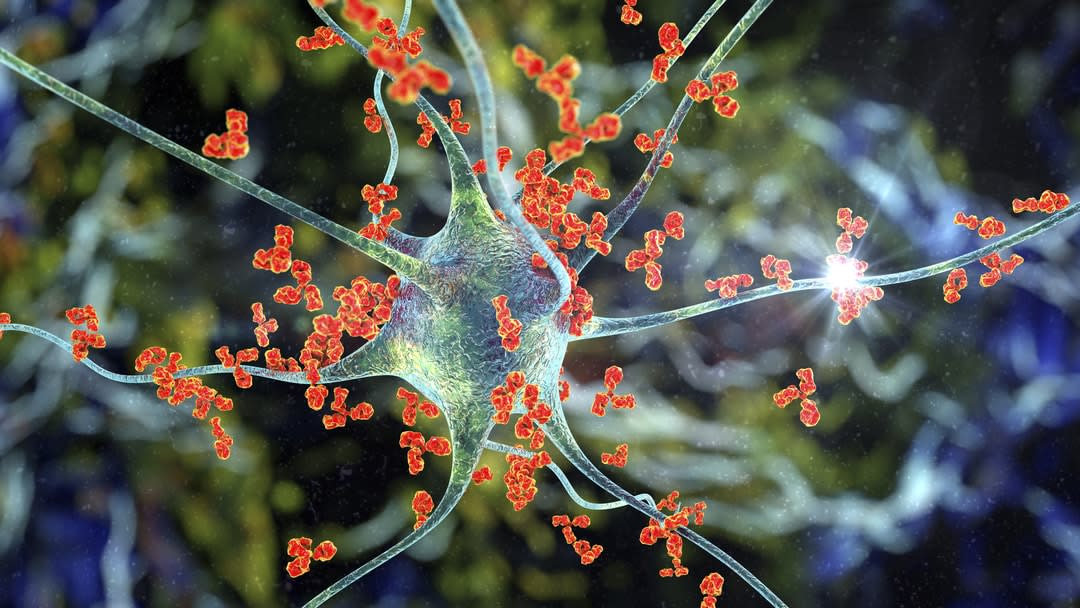
Autoimmune encephalitis: When your body attacks your brain, and people think you’re going mad

Antibodies attacking neuron.

It’s described as feeling like your brain is on fire. People with autoimmune encephalitis (AE) are often misdiagnosed as suffering from a psychiatric illness, delirium or dementia. The condition can mimic many other diseases, and hence there can be delays in diagnosis resulting in brain damage and a largely poor prognosis. The patients can be young or old, and the burden of misdiagnosed, late diagnosed or wrongly diagnosed disease can be high.

22 Jul 2020

Potent glioma tumour inhibitor discovery

Left: Glioma and immune cell (microglia) interactions within the 
tumour site. The interaction between these cells and increased 
P2X7R expression creates an environment that fuels glioma growth. 
Right: The P2X7R protein and inhibitor AZ10606120 in action. 
Image: Liyen Kan
Gliomas are the most common cancers of the brain, accounting for 80% of all brain tumours. Among these, glioblastoma is the most aggressive form, killing an estimated 225,000 people worldwide per year with patients only surviving for a median of 14-15 months after diagnosis.

Importantly, current treatment options are limited to surgical removal, radiotherapy and chemotherapy, and only prolong survival by a several months.

Despite advances in treatment, the prognosis for glioblastoma patients remains bleak. There is a desperate need for the development of more effective therapies.

25 Jun 2020

CCS wins $9M of MRFF Neurological Disorders grants

L-R: Prof Terry O'Brien, Dr Mastura Monif,
Prof Tomas Corcoran (UWA/SPHPM) and Professor Paul Myles
Congratulations to Central Clinical School researchers, Professor Terry O'Brien, Dr Mastura Monif and Professor Paul Myles, who jointly with School of Public Health and Preventive Medicine researcher Professor Tomas Corcoran have won approximately $9M of grants under the 2019 MRFF RCRDUN Neurological Disorders Mission 2020. The initiative had a total of $21.8M on offer nationwide as announced by Minister for Health Greg Hunt on 25 June 2020. See detail below.

11 May 2020

Study of 30,000 Victorians reveals 40% have low vitamin D levels

Veronica Voo is first author on the paper;
she is Dr Mastura Monif's PhD student.
by Tania Ewing

A study of 30,000 Victorians reveals 40% have low vitamin D levels, with serious health consequences.

Low levels of vitamin D have been linked to poor health consequences – from weaker bones to common conditions like diabetes and high blood pressure, as well as certain cancers.  In recent years a large body of literature has found links between vitamin D deficiency and autoimmune diseases such as multiple sclerosis (MS).

Now, a landmark study of vitamin D levels in over 30,000 Victorians attending a large Melbourne hospital between 2014 and 2017 found that only 40% of patients had levels of vitamin D that are adequate for good health. Importantly, two-thirds of men failed to have sufficient vitamin D levels.

19 Feb 2020

New technique for analysing aggressive brain tumour tissue

Immunocytochemical image of
cultured tumour cells: Katrina Kan
by Anne Crawford

A Department of Neuroscience PhD student has helped develop a new, cost-effective and reliable method for studying glioblastoma, a devastating brain cancer.

Ms Katrina Kan from Dr Mastura Monif’s laboratory, was first author on a paper about a new protocol for using primary human glioblastoma tissue, published last month in Methods and Protocols.

25 Nov 2019

Congratulations to Viertel scholarship winners Drs Mastura Monif and Andrew Neal

Drs Mastura Monif and Andrew Neal
Congratulations to Drs Mastura Monif and Andrew Neal on their award each of an $85,000 one-year clinical investigation scholarship for 2020 from the Sylvia and Charles Viertel Charitable Foundation. Both researchers are in Central Clinical School's Department of Neuroscience.

Dr Monif's project is on slowing down gliomas using antagonism of a particular protein and Dr Neal's on accurately locating sources of focal epileptic seizures using artificial intelligence (AI).

18 Sept 2018

Video playlist of the week: Neuroscience research

The recent opening of the Department of Neuroscience sees a bevy of talented researchers conducting innovative research at the Central Clinical School. A theme running through descriptions of the  research being conducted by the Department of Neuroscience is that it is "translational" and "patient-centred". The department hopes to translate the knowledge gained from lab analysis of samples, such as blood and spinal fluids, from bench to bedside. The video playlist features Dr Mastura Monif, Prof Patrick Kwan, Prof Terry O'Brien and Dr David Wright. See more:


  • Video playlist: www.youtube.com/playlist?list=PL77QJnB61-H7rR7u0ZVhwYmeSfaIN17m4
  • Photo album: photos.app.goo.gl/9TbgT3dCfve6K9fz6
  • Neuroscience department research groups: www.monash.edu/medicine/ccs/neuroscience/research
  • 24 Aug 2018

    Photo of the week: Neuroscience in action

    Dr Mastura Monif's group. R-L: Ms Veronica Woo, Group Leader Dr Mastura Monif, Mr William O'Brien, Dr Robb Wesselingh and Ms Katrina Kan.
    The new Department of Neuroscience at the Alfred Hospital Medical Research Precinct is being officially launched on Thursday 30 August 2018. You can RSVP & see more here:

    4 May 2018

    Video of the week: Red Lab Coat Day 2018 - Kiss Goodbye to MS

     
    Every year on 1 May 1 research groups throughout Australia participate in Red Lab Coat Day. The day aims to raise the profile of and funding for research on multiple sclerosis organized.
     
    This year your CCS Neuroscience MS researchers have put together a hilarious video for the 'Kiss Goodbye to MS' campaign to raise awareness and funds. The video is part of the 'Battle of the Labs', and Helmut Butzkueven, Vilija Jokabaitis, Mastura Monif, Steven Petratos and Anneke van der Walt would love you to vote for it. They want to win the surprise prize!
     

    Please share the link with all your family, friends and colleagues, ask them to ‘kiss’ (vote) for their favourite and post on your social media using the attached social tiles and the #KissGoodbyeToMS and #RedLabCoatDay hashtags.
     
    See the video and the photo gallery here:


    27 Apr 2018

    Photo of the week: Dr Mastura Monif's research group

    2018 Monif group. L-R: Ms Katrina Kan, Mr William O'Brien, Dr Mastura Monif, Dr Robb Wesselingh, Ms Veronica Woo, Dr James Broadley. Dr Monif is one of the research leaders in the new Department of Neuroscience, specializing in neurology, neuroinflammation and neurological diseases. See more about her group at
    www.monash.edu/medicine/ccs/neuroscience/research/monif-group
    See more about the department's research at www.monash.edu/medicine/ccs/neuroscience/research
    Related Posts Plugin for WordPress, Blogger...